Hermann Hesse
1877 - 1962
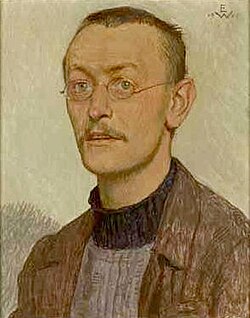
Herman Hesse was a German author active from the 1900s to the 1940s. He is known for being one of the few German writers to oppose the First World War, and for writing novels inspired by Eastern religion, philosophy, and mysticism. His attempts to combine German and Eastern influences are a large part of his novels' appeal.
Hesse’s novels are all concerned with spiritual journeys: attempts by the main character to become their true self. This often involves physical journeys and relationships with mentor figures. Some of these journeys end in success, some in failure, but the most interesting of them conclude with an ambiguous state somewhere between success and failure.
While his works aren’t formulaic, motifs and themes recur throughout the novels as he attempts to grapple with the same problems again and again. In almost all cases, the main character is an intellectual and often aspires to be an artist. A major conflict they confront is the relative value of their book-learning when compared with the simple experience of living one’s life. Another concern is the nature of evil — the ways in which society and the individual cooperate to produce the feeling of “sin.” At the heart of all of this is the question of how a person can possibly live a good, authentic life.
The slight deviations and shifts of focus, especially as Hesse grows older, are what make his bibliography feel so expressive. Hesse himself doesn’t try to pacify us with easy answers, but instead attempts to communicate just how difficult these questions truly are.
My Top Five
- The Steppenwolf (1927)
- Demian (1919)
- The Glass Bead Game(1943)
- Journey to the East (1932)
- Siddhartha (1922)
WORKS
Peter Camenzind (1904)
Peter Camenzind contains many elements that will recur in Hesse’s later novels, but never fleshed out to the same degree. Peter’s adolescent experiences are almost point-for-point the same as Emil Sinclair’s in Demian, except that they take only a few paragraphs to unfold, rather than an entire novel. On top of that, they lack Demian’s religious and intellectual dimension; Peter Camenzind could be described as a philosophical novel, but it’s the philosophy of the “good life,” rather than an attempt to understand the hidden nature of things.
Peter himself is a man somewhat unsure whether to live life or to write about it, and for much of his life he does neither. He leaves his small village in order to make something of himself and his education, but finds the only lessons worth learning are ethical, rather than intellectual.
Demian (1919)
A young man named Emil Sinclair finds himself trapped between his bourgeois upbringing and a longing to be initiated into life’s great mysteries (also known as the “Dark World.”) He is carried along by his interest in an older student named Max Demian, and eventually finds himself caught in a series of intellectual, philosophical, and religious quagmires, on his search to “live the life that was spontaneously welling up within [him.]”
A great starting point for Hesse’s works, as it introduces all the core concepts through a younger character, still trying to figure himself out. A psychological portrait with many great images and moments, as well as plentiful ambiguities to turn over in one’s mind.
See more: My youtube video about Demian
Siddhartha (1922)
Hesse’s most direct depiction of Eastern religion and philosophy. It recounts the life of a man in India during Buddha-times who takes a circuitous path on his way to enlightenment. Not satisfied with following the teachings of others (including the Buddha himself) he sets out on a tempestuous journey through the vicissitudes of life.
While it reads today like a fairly bog-standard allegorical enlightenment journey, I believe some credit is due to Hesse for the fact that this was far from a recognizable genre in European literature at the time. On top of this, it manages to be far less annoying than any of its predecessors, and might still impress readers with how effectively it manages to tell a story they might think they already know.
Steppenwolf (1927)
I have a tendency to read this as a spiritual sequel to Demian, following a much older character who seems to have gone through much of the tribulations of an Emil Sinclair and emerged, in the end, far from enlightened. Disenchanted with the “Dark World,” the self-described “Steppenwolf” Harry Haller is forced to re-integrate with a society that he both rejected and was rejected by.
The novel contains a great deal of “magical” motifs and nigh-psychedelic moments, even ending with a lengthy fantastical dream sequence. Compared to Siddhartha, Harry Haller’s success is less decisive, reflecting a more problematic attitude toward the type of “spiritual journeys” Hesse is so fascinated by. For this reason, I believe it is Hesse’s most effective work.
See more: My Youtube video about Steppenwolf
Journey to the East (1932)
An account of a man named H.H., and his continuous attempts to write a chronicle of a Journey to the East he undertook in his youth. This Journey was sanctioned by an organization known as the League, which had apparently existed for centuries, and included as members all of history’s greatest minds. This Journey, however, ended in failure and dissolution, and for many years, H.H. has lived in despair, believing the League to have disappeared entirely, while the drafts of his chronicle always end up feeling incomplete and unsatisfactory.
This is a short, allegorical work — the Journey itself is a journey not only through space, but through time. It includes historical figures, fellow artists, and even characters from Hesse’s works, including Klingsor (from Klingsor’s Last Summer) and Vasudeva (from Siddhartha.) I read it as an attempt by Hesse to reconnect with himself as an artist, and understand the relationship between his life and his art.
The Glass Bead Game (1943) (also known as Magister Ludi)
A fictional biography of Joseph Knecht, a master of the “Glass Bead Game,” an esoteric activity that involves forming connections between ideas, works of art, music, etc. The nature of the game is kept ambiguous, but it can be seen as the highest form of human knowledge, synthesizing art, philosophy, and science in the form of an aesthetically beautiful and cooperative endeavour. Practitioners of the game live apart from society in their own Utopian province.
Over the course of the novel, Knecht begins to doubt the significance of the game, and whether its worth devoting one’s life to at the expense of all connection with contemporary human society. The novel concludes with three stories written by Knecht himself, in which he imagines different lives.
Along with Journey to the East, it is one of Hesse’s more abstract works, and reflects his later tendency toward allegory rather than psychological realism. That being said, it might be more accurate to say that it is a fusion of the two, in a unique Hesse-ian way. The structure gives it a less personal tone than his other novels, and it reflects an interest in general “society” that is lacking in his other novels, which are always focused on the individual. Many see it as the culmination of his work, but I see it more as a step in a slightly different direction.
FURTHER READING
The Novels of Hermann Hesse by Theodor Ziolkowsi (1965)
UNREAD
- Beneath the Wheel (1906)
- Gertrud (1910))
- Rosshalde (1914)
- Knulp (1915)
- Klingsor’s Last Summer (1920)
- Narcissus and Goldmund (1930))